

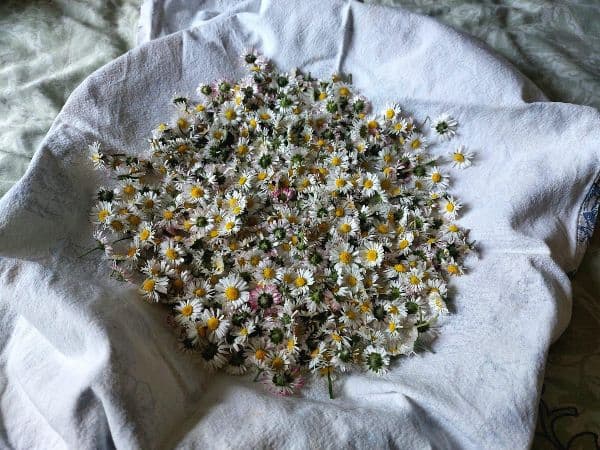
Spring means it’s time to start making daisy oil for the Dublin Herb Bike apothecary. Although you can find daisies underfoot in Ireland pretty much all year long (I’ve picked some in Phoenix Park in December), spring is when they burst into abundance. You will find masses of them growing across lawns and along pathways. They don’t mind being mowed or trampled, similar to our good friend Plantain.
The ‘Common European Daisy’ or ‘Lawn Daisy’ (botanical name: Bellis perennis ) grows all across Ireland. And while it’s not native to the States, but it has been introduced in some areas around the northern US and out west. Here is a link that shows USA distribution: https://plants.usda.gov/plant-profile/BEPE2
Daisy is a great alternative to Arnica that we can use in trauma blends. It is important that we find alternatives to Arnica due to many reasons: over-harvesting in the wild, lack of cultivation, climate change, and the ever expanding footprint of man.
And one thing that makes Daisy even more badass for use in traumatic situations, is that not only is it wonderful for bumps and bruises, but you can also use it on broken skin, something that is contraindicated when working with Arnica.
While in this newsletter, we are focusing on Daisy for topical applications, daisy is also an edible – sprinkle flowers into a salad or cook the leaves as a pot herb. Again, we might contrast this to Arnica which is considered a low-dose botanical and only taken internally with care!
But back to our friend Daisy, who is abundant, versatile, and safe and absolutely adorable…what’s not to love! ????
Making Daisy Oil: Step by Step


Making Pain Re-Leaf Salve
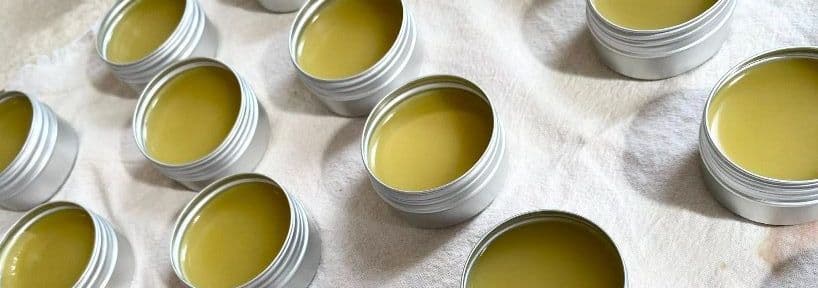
Daisy is one of the stars in our Pain Re-Leaf Salve. Here is our recipe card for a couple of our regional variations. You will notice that while we used Arnica oil in our Atlanta blend (often sourced from the Rocky Mountains using Arnica cordifolia), we are able to use Daisy in our Dublin version.
This salve is one of our most popular items at the clinic. It helps with all sorts of aches and pains and smells great. We have made many variations over the years, and you will too, as you play with what ingredients are local to you and easier to source.
Typically we set up our fresh oils individually, as different herbs are in season at different times (Daisy in the spring and St. John’s Wort in the summer for example) and then we blend them together to create our recipes as needed. Dry oil blends can be set up at any time.
TO MAKE – Basic instructions
You can find detailed salve making worksheets in the Toolkit.
- Blend oils (see our Pain Re-Leaf recipes below)
- Melt in Beeswax at a 1:5 ratio (for example, one ounce of beeswax to every 5 fluid oz of oil blend)
- Add the essential oils (optional)
- Pour into salve pots, allow to harden and then pop on the lid.
- Label!
Usage: Apply liberally to ease the pain of sprains, strains, bruises, and arthritic conditions.
Contraindiations & Safety: If your blend contains Arnica, do not apply to broken skin. Keep away from eyes. And please, use common sense.
Pain Re-Leaf Blend (Dublin Formula)
- 1 part Calendula Oil
- 1 part Daisy Oil
- 1 part St. John’s Wort Oil
- Optional: 1 part of Ginger and/or Cayenne Oil for warming version
- Wintergreen Essential Oil at a 2% dilution
Pain Re-Leaf Blend (Original ATL Formula)
- 1 part Dry Herb Base Oil Blend. We make this blend in advance using the following formula. Since many of the herbs in this formula are quite resinous, we first moisten the powdered herbs with a bit of ethanol and leave to pre-macerate in a sealed container overnight before adding in the oil to steep.
1 part Calendula Flowers
½ part Ginger Powder
½ part. Myrrh Powder
½ part. Cayenne Powder
½ part Frankincense Powder
½ part Sweetgum Balls
- Fresh Oils – ½ part each of Arnica (or Daisy) and St. John’s Wort
- Wintergreen Essential Oil at a 2% dilution
You can find this recipe and ALL THE RECIPES we use at the Herbalista Free Clinic in our member Toolkit. Available to our sustaining members, we hope the Herbalista Toolkit supports you on your herbal journey, just as your support helps us continue ours. ????


