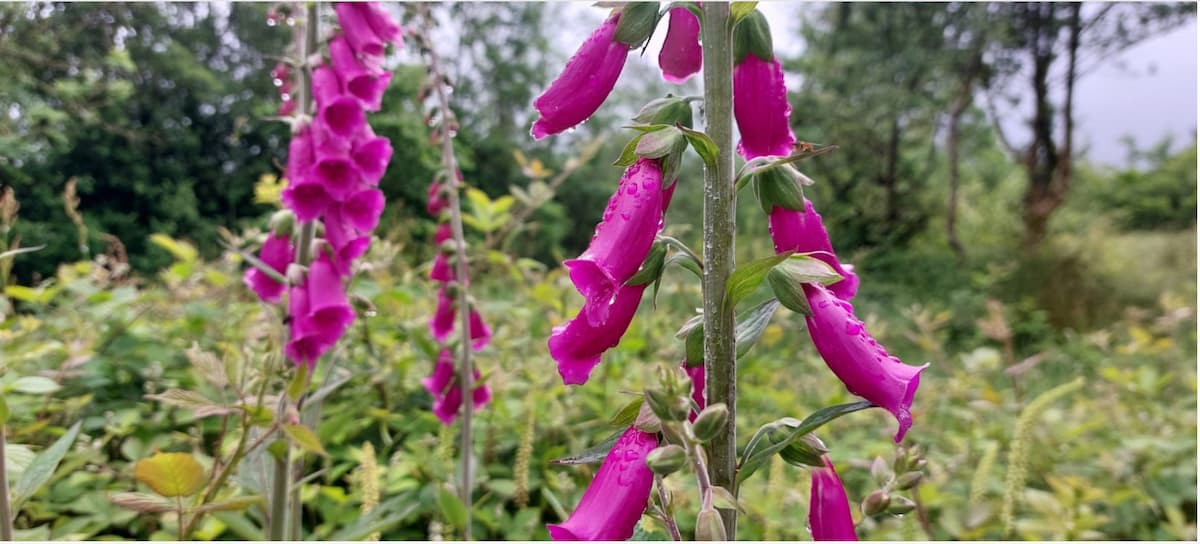
There’s just something about Foxgloves. They demand our attention, transforming a disturbed patch of roadside or a simple rock wall with striking, pink floral spikes. And how I treasure the sweet moment when you notice a fuzzy little bee trying to squeeze into their delicate tubular flowers.
Here, in its native Ireland, Foxglove is a widespread and abundant plant. And like any immigrant, as I settle into my life in Ireland, I am trying to make connections and build relationships.
And as an immigrant herbalist, this means meeting the plants and learning their stories from the folks who have lived amongst them.
Foxglove is famous both as a great medicinal AND a great poison, and so it often features prominently in the old herbals and tales passed down through the generations.
Early mentions of Foxglove (aka Sticatos) in medievel Irish medical texts (such as Tadhg Ó Cuinn’s 1415 herbal) describe it as a diuretic to help with abdominal swellings. Those understandings evolve over the centuries and come the 1800’s, we can then read Dublin-based Dr. Stokes’ detailed case studies about the use of Foxglove (aka Digitalis) in cases of dropsy (congestive heart failure) to slow yet strengthen a weak and failing heart, aiding the body to expell accumulated fluids.
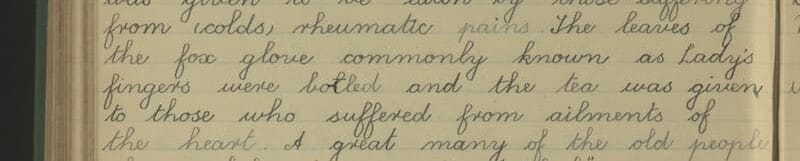
Browsing the National Folklore Collection (Dúchas.ie) for Foxglove (aka Lus Mór) we can discover many tales of cures and curiosities in their Schools’ Collection (Bailiúchán na Scol) that was gathered in the late 1930’s. Written in the sweetest and most careful cursive lettering, these stories helped to preserve generational knowledge, that having survived hundreds and even thousands of years, were suddenly vanishing as candlelight storytelling gave way to electrified mass-media culture.
In these writings, we meet Foxglove the heart medicine…
Foxglove the poison…
and Foxglove the fabulous fairy fashion accessory…
Quite a complex character, the Foxglove. But aren’t we all.
We hope to see you round at some of our happenings this month, including the launch of our Certificate Track for the Herbal Foundations Course. You can find all the deets below.
May is for MAGIC. And MULBERRIES and MIMOSA blossoms…and well, so many of my favorite things. And now I’m adding MAUGHANACLEA to that list. The photo below was taken looking out over the Maughanaclea hills of West Cork.
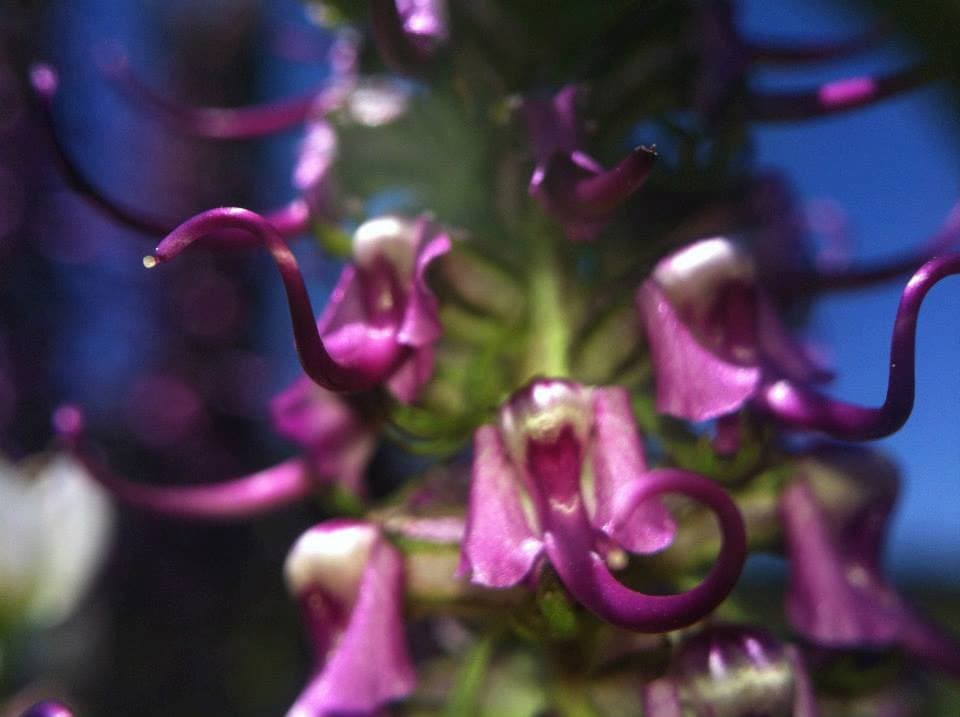
And as we enter the summer season on this Bealtaine weekend, with its long stretch of the day, I feel a kindling in my heart for the warmer days ahead. On my walks, I am discovering all the lovely plants growing here, including a sweet patch of Pedicularis sylvatica pictured below. Also known as Dwarf Red Rattle or Lousewort, this low growing plant is found across Ireland and particularly likes wet, grassy and boggy ground.
For folks who have followed Herbalista for a time, you will know that the Pedicularis genus holds a special place in my heart. In fact, it features on our very first logo, as the Herb Bus takes flight on the leaves of Pedicularis canadensis, the native Pedicularis of the Southern Appalachian mountains.Pedicularis is what’s known as a hemi-parasite, whereby it derives some of its nutrition by feeding off the other plants it grows alongside. And while this means you need to be very aware of the plants it is growing with and never harvest it when growing alongside plants that could be poisonous to humans, it also means that you can appreciate that little extra bit of magic it has when growing amongst the wild roses (as I have done when harvesting from just such a patch in Colorado).
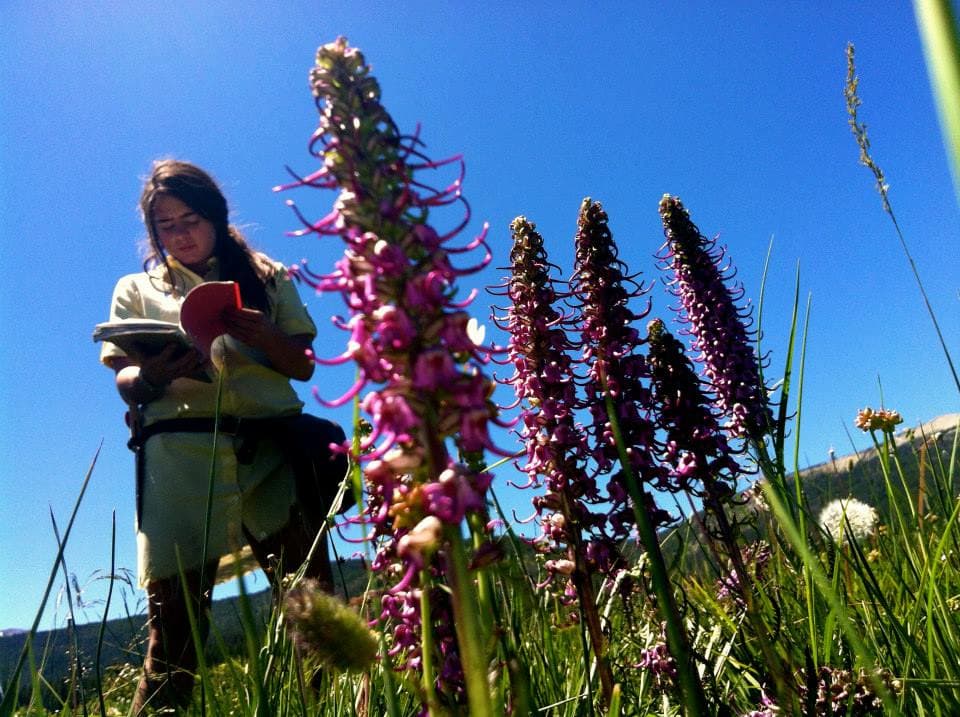
Pedicularis also reminds me that we too are fed by those around us and so must try and surround ourselves as often as we can with beautiful and giving community.There are many species of Pedicularis growing across the United States, including the particularly mesmerizing P. groenlandica (aka Elephant’s Head) pictured below. This patch we came across in Montana. It’s easy to se how it got the name Elephant’s Head.
In the States, Pedicularis is a mainstay as a relaxant nervine, and finds its way into many a blend. We rely on it a lot at our First Aid Stations, either alone, or blended with other pain relieving and relaxing herbs such as Skullcap, Passionflower or Valerian.
We would always chuckle that it was a member of “nervine row” as our tincture kits are arranged by botanical name and you would often find Pedicularis sat next to a few other wonderfully relaxing nervines –Passiflora, Piper, and Piscidia.
I’m looking forward to getting to know Dwarf Red Rattle a bit better now, as one of the two Pedicularis species growing here in Ireland. Culpepper spoke of it being used to “heal fistulas and hollow ulcers and to stay the flux of humours in them as also the abundance of the courses or any other flux of blood, being boiled in port wine and drunk”. In other words, it was used to heal wounds and as a styptic.
Nibbling on the leaves just now, it has a taste that reminds me of home.
We have a lot of lovely happenings this month – in Atlanta, Ireland, and online. Hope you can join the gatherings or that you have a lovely herbal community to enjoy these days with wherever you are.
Spring means it’s time to start making daisy oil for the Dublin Herb Bike apothecary. Although you can find daisies underfoot in Ireland pretty much all year long (I’ve picked some in Phoenix Park in December), spring is when they burst into abundance. You will find masses of them growing across lawns and along pathways. They don’t mind being mowed or trampled, similar to our good friend Plantain.
The ‘Common European Daisy’ or ‘Lawn Daisy’ (botanical name: Bellis perennis ) grows all across Ireland. And while it’s not native to the States, but it has been introduced in some areas around the northern US and out west. Here is a link that shows USA distribution: https://plants.usda.gov/plant-profile/BEPE2
Daisy is a great alternative to Arnica that we can use in trauma blends. It is important that we find alternatives to Arnica due to many reasons: over-harvesting in the wild, lack of cultivation, climate change, and the ever expanding footprint of man.
And one thing that makes Daisy even more badass for use in traumatic situations, is that not only is it wonderful for bumps and bruises, but you can also use it on broken skin, something that is contraindicated when working with Arnica.
While in this newsletter, we are focusing on Daisy for topical applications, daisy is also an edible – sprinkle flowers into a salad or cook the leaves as a pot herb. Again, we might contrast this to Arnica which is considered a low-dose botanical and only taken internally with care!
But back to our friend Daisy, who is abundant, versatile, and safe and absolutely adorable…what’s not to love! ????
Making Daisy Oil: Step by Step
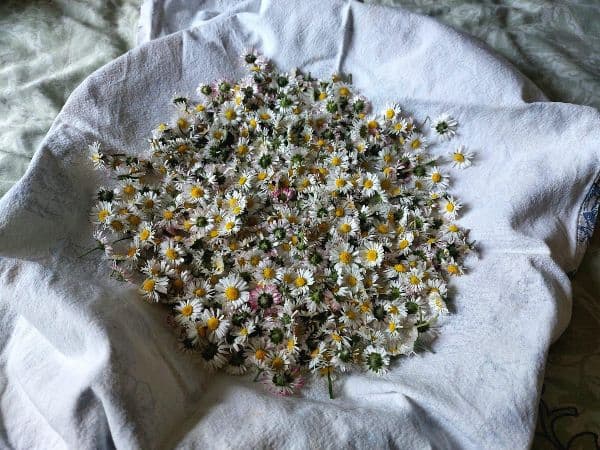
Go frolicking in the meadow, gather a basketful of daisies and then just let the flowers air dry for a day to evaporate some of the excess water before infusing in the oil.
Fill your jar with daisies, covering them in extra virgin, cold pressed olive oil. Fill the jar all the way to the tippy top, poking out any bubbles with a chopstick. Make sure the flowers are completely submerged under the oil. Put the lid on and set the jar on a plate, to catch any drooling drips. You will let it steep for a month. No need to shake.
After steeping for a month or so, hand press through a piece of muslin or simply pour it through a fine meshed strainer. Compost the daisies and bottle your gorgeous oil. Don’t forget to label it with all your important bits of information. Store your oil in a cool, dark location.
Making Pain Re-Leaf Salve
Daisy is one of the stars in our Pain Re-Leaf Salve. Here is our recipe card for a couple of our regional variations. You will notice that while we used Arnica oil in our Atlanta blend (often sourced from the Rocky Mountains using Arnica cordifolia), we are able to use Daisy in our Dublin version.
This salve is one of our most popular items at the clinic. It helps with all sorts of aches and pains and smells great. We have made many variations over the years, and you will too, as you play with what ingredients are local to you and easier to source.
Typically we set up our fresh oils individually, as different herbs are in season at different times (Daisy in the spring and St. John’s Wort in the summer for example) and then we blend them together to create our recipes as needed. Dry oil blends can be set up at any time.
TO MAKE – Basic instructions
You can find detailed salve making worksheets in the Toolkit.
Blend oils (see our Pain Re-Leaf recipes below)
Melt in Beeswax at a 1:5 ratio (for example, one ounce of beeswax to every 5 fluid oz of oil blend)
Add the essential oils (optional)
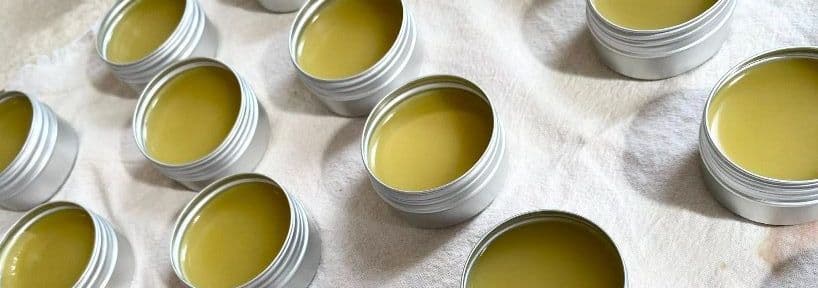
Pour into salve pots, allow to harden and then pop on the lid.
Label!
Usage: Apply liberally to ease the pain of sprains, strains, bruises, and arthritic conditions.
Contraindiations & Safety: If your blend contains Arnica, do not apply to broken skin. Keep away from eyes. And please, use common sense.
Pain Re-Leaf Blend (Dublin Formula)
1 part Calendula Oil
1 part Daisy Oil
1 part St. John’s Wort Oil
Optional: 1 part of Ginger and/or Cayenne Oil for warming version
Wintergreen Essential Oil at a 2% dilution
Pain Re-Leaf Blend (Original ATL Formula)
1 part Dry Herb Base Oil Blend. We make this blend in advance using the following formula. Since many of the herbs in this formula are quite resinous, we first moisten the powdered herbs with a bit of ethanol and leave to pre-macerate in a sealed container overnight before adding in the oil to steep.
1 part Calendula Flowers ½ part Ginger Powder ½ part. Myrrh Powder ½ part. Cayenne Powder ½ part Frankincense Powder ½ part Sweetgum Balls
Fresh Oils – ½ part each of Arnica (or Daisy) and St. John’s Wort
You can find this recipe and ALL THE RECIPES we use at the Herbalista Free Clinic in our member Toolkit. Available to our sustaining members, we hope the Herbalista Toolkit supports you on your herbal journey, just as your support helps us continue ours. ????
As we move into summer, the season of love and action, I felt it was important to celebrate hope. And honestly, it took a while for me to figure out how I would share that feeling, how I could help generate optimism in a time many of us feel deep despair. How do we move forward with positivity when so many people are hurting, wars are raging, when the social contract feels broken and the world is brimming with microplastics?
Floundering as I was, with a massive case of writer’s block, I went out looking for inspiration and walked my favorite paths through town, along the hidden alleyways of Dublin. And as I gazed upon the nettles escaping industrial fences and at honeysuckle vines peering over high stone walls, I remembered that it’s always been the plants that give me hope in these desperate times.
I thought of the many photos I’ve taken over the years and how I’ve always been drawn to these moments that show plants triumphing against all odds, such as the mallow glowing against a backdrop of neglect
There’s an optimism in these framings and they remind us that the plants always find a way to bloom and to live their purpose, no matter the circumstance. And if the plants can do it, why not us? Are we not also children of nature, equipped with miraculous gifts?
So when you see that cleavers clinging to the side of a wall or geraniums erupting out of cracks in the concrete, let it be a sweet reminder of our own resilience. And in this summer season, may our winter dreams and spring impulses step into the light and flourish in the sun.
We hope you can join us at this month’s bouquet of happenings. For those further afield, we’ve also shared a basketful of summer resources to help you create herbal happenings in your neck of the woods.
EDIBLE & MEDICINAL PLANT RAMBLE Saturday, May 9, 2015 2:00pm – 4:00pm Along the Eastside Hiking Trail of the Beltline Suggested Donation: $20 (or become a $5/mth sustainer and enjoy plant walks all … Read more
In celebration of Valentine’s Day, we launched our Grow a Row program. What better way to share your love for community than to become involved in its health and wellbeing. … Read more
You don’t have to live on a pristine mountainside or disappear into the wilderness to be an herbalist and have a meaningful relationship with your local plant medicine. In our … Read more
GROW A ROW for the HERBALISTA FREE CLINIC! Together with the Funny Farm of Stone Mountain, we are excited to share the launch of our new project — Grow … Read more
Here at Herbalista Headquarters we are always striving to come up with creative ways to make our endeavors sustainable and effective. Being flexible, allowing projects to shift and change over … Read more